When managers put their own money into the company they run, the signal can matter more than the amount.
A Small Purchase With a Larger Message
BAIC Group said on March 3 that vehicle sales in January and February exceeded 210,000 units, with February volume up 18% year on year. That sales update came alongside a more symbolic announcement from BAIC BluePark.
A total of 22 core executives across BAIC Group and BAIC BluePark, led by BAIC Group chairman Zhang Jianyong, general manager Chang Rui and BAIC BluePark chairman Zhang Guofu, bought shares with their own funds. The total purchase was about $2.1 million, equal to 0.0293% of the company's total share capital, at an average cost of roughly $1.14 per share.
The amount is not large in capital-market terms. The meaning is larger. BAIC BluePark, once called China's first listed new-energy vehicle stock, has spent years working through a painful transition. The collective purchase looks less like routine market-value management and more like an effort to bind management interest to the company's future.
Real Money, Real Risk
The most important feature is how the purchase was made. Unlike common equity incentives, discounted private placements or option grants, the 22 executives bought shares on the secondary market at current prices with their own money. They received no discount, no performance backstop and no safety cushion.
That places them on the same risk line as retail investors and outside institutions. Their personal wealth is directly tied to the company's share price.
The pricing adds another signal. The average purchase price of about $1.14 per share was higher than the roughly $1.04 per share issue price in BAIC BluePark's $828 million private placement completed at the end of January 2026. Institutions such as E Fund gained a lower entry cost through scale, while internal managers bought at a premium of about 8.86%.
The purchases covered senior decision-makers and operating leaders rather than one or two executives. Zhang Jianyong bought about $140,000 of shares. Zhang Guofu bought about $139,000. BAIC BluePark general manager Liu Guanqiao bought about $138,000. Ma Lei, president of the Stelato business unit, bought about $138,000, and vice-president Sun Guiyang bought about $139,000. The other 16 core managers generally bought between about $69,000 and $83,000 each.
Across the group, the average investment was nearly $97,000 per person. That creates a common interest chain from strategy to execution.
The company also said all shares purchased by management would not be sold within six months. That lock-up overlaps with the lock-up period for some investors in the January private placement, creating a shared first-half-2026 test window for executives and outside investors.
A Governance Icebreaker
The purchase is not a complete partner system. It is better understood as a first step in governance reform.
The shareholding ratio is small, but the market-based method matters. Within the framework of a state-owned enterprise, executives are taking market risk directly. That is a cautious but meaningful attempt to introduce more entrepreneurial accountability.
A real business-partner system usually depends on three elements: shared interest, shared risk and long-term binding. BAIC BluePark's purchase touches all three. Personal funds connect managers to market value and performance. Open-market buying and the lock-up period force more responsible decision-making. The timing anchors the purchase to an important product and strategy cycle.
Zhang Guofu has repeatedly described BAIC BluePark as an entrepreneurial company. This share purchase turns that slogan into a form of contract backed by personal money.

A Turnaround Under Pressure
The move comes against a difficult history. Since 2020, BAIC BluePark has accumulated losses of more than $4.7 billion. The company struggled during its shift from business-to-business sales toward consumer-market competition.
Signs of recovery appeared in 2025. Full-year sales exceeded 200,000 units, up 84%. The Arcfox brand passed 160,000 units and doubled for a third consecutive year. Stelato exceeded 10,000 units in December and entered a more positive growth track. In the third quarter of 2025, the company's gross margin turned positive for the first time at 1.8%, while revenue grew for three straight quarters.
That makes the management purchase more significant. Zhang Jianyong's statement that failure to meet targets would mean the management team itself was not good enough gives the purchase the tone of a performance pledge. Internally, it can help push the organisation away from state-owned-enterprise complacency. Externally, it can support investor confidence. For strategic partners such as Huawei, it signals that BAIC is committed to the cooperation.

Performance Still Matters Most
The share purchase is a starting point, not proof of success. BAIC BluePark's share price did not move dramatically after the announcement, which shows that investors still want hard operating evidence.
Early 2026 data are improving. In February, BAIC BluePark sold 7,364 vehicles, up 18.26% year on year. January-February cumulative sales reached 15,437 units, up 14.81%. The product cycle and technology pipeline now matter most.
On the product side, Stelato and Arcfox are expected to push higher-end segments together. Stelato plans a hardcore luxury SUV in the second quarter and a luxury MPV in the fourth quarter, strengthening its position in the roughly $41,000 to $69,000 range. Arcfox is launching the Alpha S5 and the premium Wendao V9 MPV to cover mainstream and business demand.
BAIC BluePark also plans to invest about $275 million to upgrade the Stelato super factory, supporting future capacity.
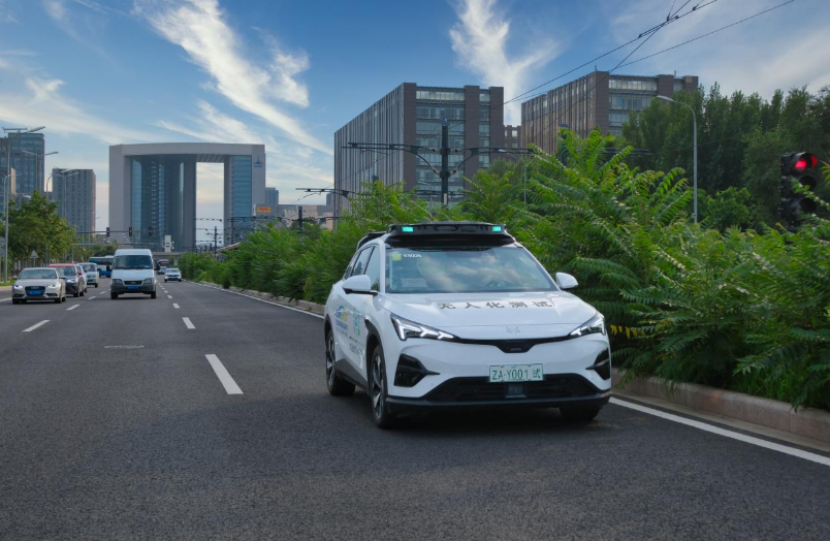
On technology, BAIC BluePark says it is one of the few Chinese automakers covering L2 to L4 automated driving across the full stack. Its Level 3 automated-driving system has received one of China's first market-access approvals and is planned for individual users in the second quarter. Its Level 4 robotaxi project with Pony.ai is expected to deploy 3,000 units this year and begin overseas expansion.
The Stelato leadership team's purchases above $138,000 each also send a clear message to Huawei. BAIC is trying to show that it is not merely a contract manufacturer, but a deep strategic partner in Huawei's smart-car ecosystem.
An Entrepreneurial Contract
The $2.1 million executive purchase will not change BAIC BluePark's balance sheet. Its symbolic value is the point. The company is trying to break some of the inertia associated with state ownership and create a management team that shares both upside and downside with shareholders.
In China's increasingly harsh new-energy vehicle market, capital and technology are essential. A core team willing to tie its own wealth to the company's future is also valuable.
BAIC BluePark still has to prove the turnaround through products, margins and sustained sales. The purchase gives the company a stronger internal contract. The market will judge whether that contract produces results.