China's new-energy vehicle industry has no shortage of technology claims.
A Practical Charging Breakthrough
What it still needs are solutions that address persistent user pain points. BYD's latest flash-charging event was important because it targeted several of them at once: charging time, battery safety, cold-weather performance and grid pressure.
The event focused on two major technologies: the second-generation Blade Battery and megawatt-class Super Flash Charging. Together, they suggest BYD is trying to push liquid battery technology close to its practical limit before solid-state batteries are ready for large-scale production.
The message was direct. If EVs are to replace petrol cars at scale, replenishment must become nearly as easy as refuelling.
The Second-Generation Blade Battery
BYD's original Blade Battery built its reputation on safety, especially its ability to pass nail-penetration testing without fire. That made it a benchmark in lithium iron phosphate battery technology. The second generation is designed to keep that safety base while addressing the common criticism that LFP batteries lag ternary lithium batteries in range and performance.
BYD says the new battery has already passed the full set of China's updated power-battery safety standards due to take effect in 2026. Under extreme crush, puncture and high-temperature conditions, it still avoids fire and explosion.
The structure also changes. The second-generation Blade Battery keeps the blade-cell advantage but uses a shorter blade design with CTB 2.0 cell-to-body integration, improving pack structural strength and space utilisation.
The larger step is chemistry. BYD uses a lithium manganese iron phosphate composite cathode and a silicon-carbon anode, lifting system energy density toward mainstream ternary battery levels. The company claims CLTC range above 1,000km and more than 80% capacity retention at minus 30C, with winter range loss controlled within 15%.
That matters because solid-state batteries are still mostly in development and remain some distance from mass-market installation. By improving liquid battery performance while controlling cost, BYD can put the technology into production quickly. The Song Ultra, starting at about $21,000, is the clearest example of that strategy.
Nine Minutes to Nearly Full
Fast charging is not new. The difference with BYD's megawatt-class Super Flash Charging is that the company is presenting a full system covering battery chemistry, high-voltage architecture, charging equipment and energy-storage support.
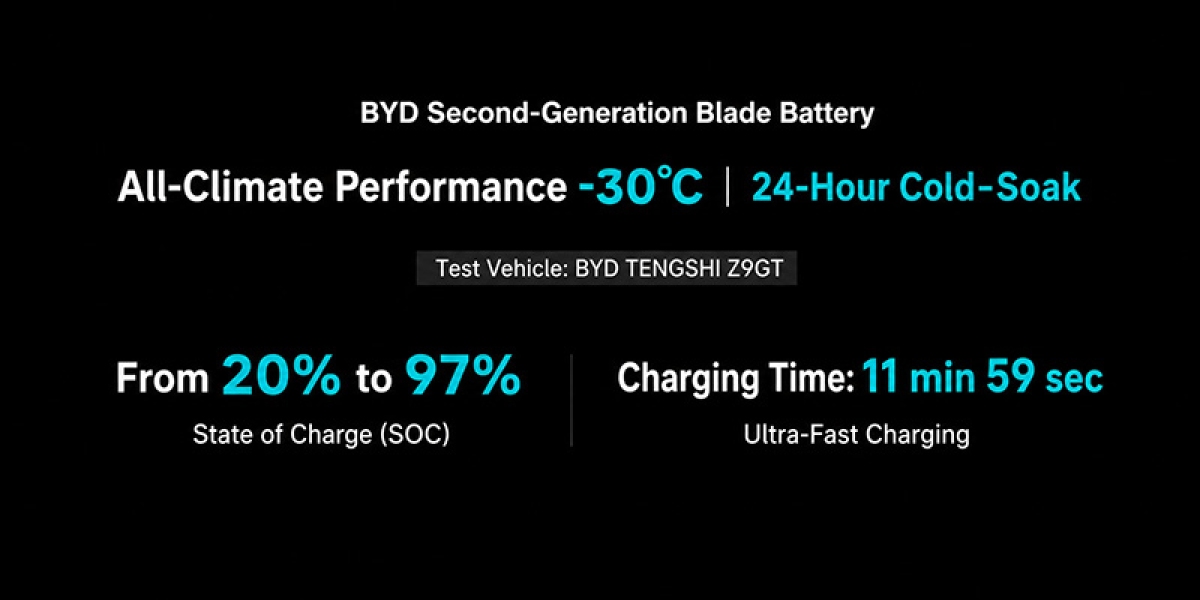
The headline number is simple: charging from 10% to 97% in nine minutes. In normal temperatures, BYD says the system can charge from 10% to 70% in five minutes and reach nearly full charge in nine. At minus 30C, it can charge from 20% to 97% in 12 minutes, only a few minutes slower than in normal conditions.
Higher power alone is not enough. Extreme charging can damage batteries if thermal control and voltage architecture are not managed properly. BYD's answer is an all-domain 1,000V high-voltage architecture, 8C high-rate charging and a full liquid-cooling thermal-management system. The goal is to combine speed with battery life.
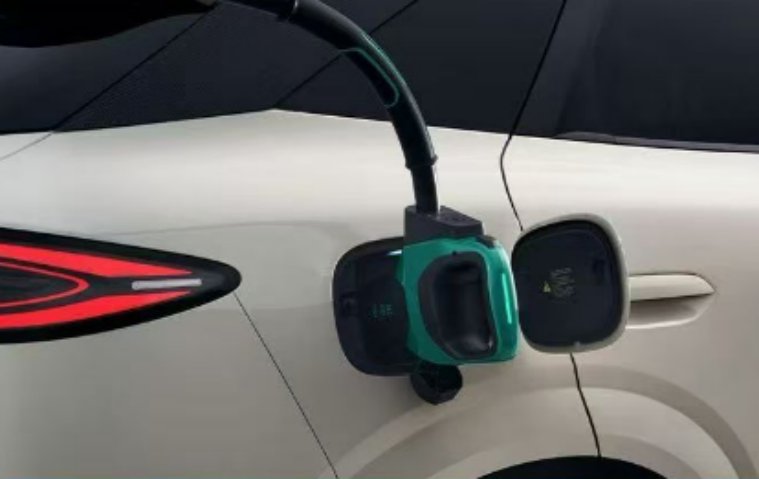
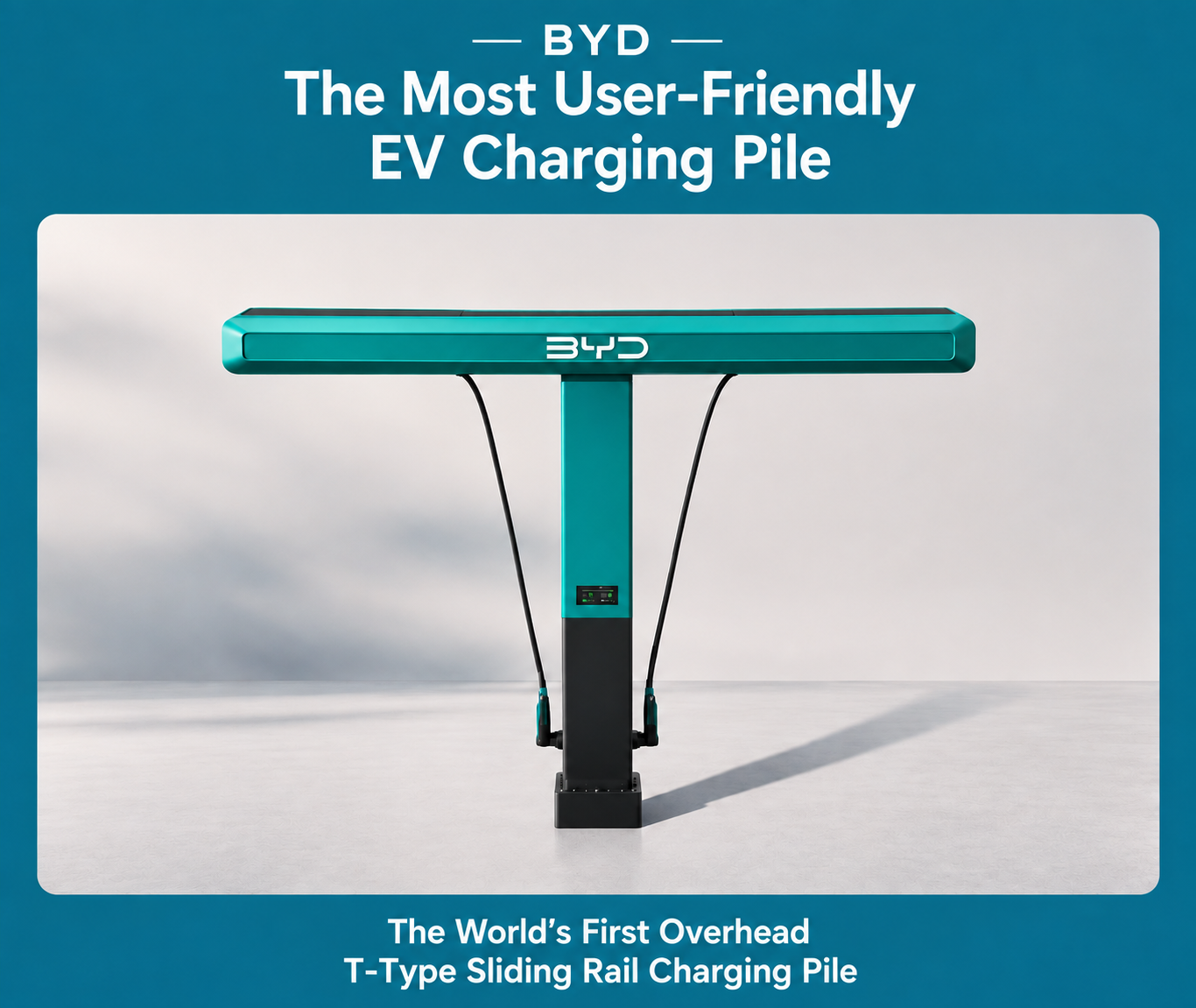
The company also addressed the usability of the charging hardware. High-power charging guns are often thick and heavy, making them awkward for some users. BYD has reduced the liquid-cooled charging gun to 2kg and added a sliding rail-style movement design so it can be handled with one hand. Each supercharging pile occupies only 1.5 square metres, making it easier to deploy in highway service areas, shopping-centre garages and residential parking areas.
The system is compatible with 200V to 1,000V platforms, meaning older EVs and other brands can also use the infrastructure, even if they cannot reach BYD's maximum charging speeds.
Closing the Grid Loop
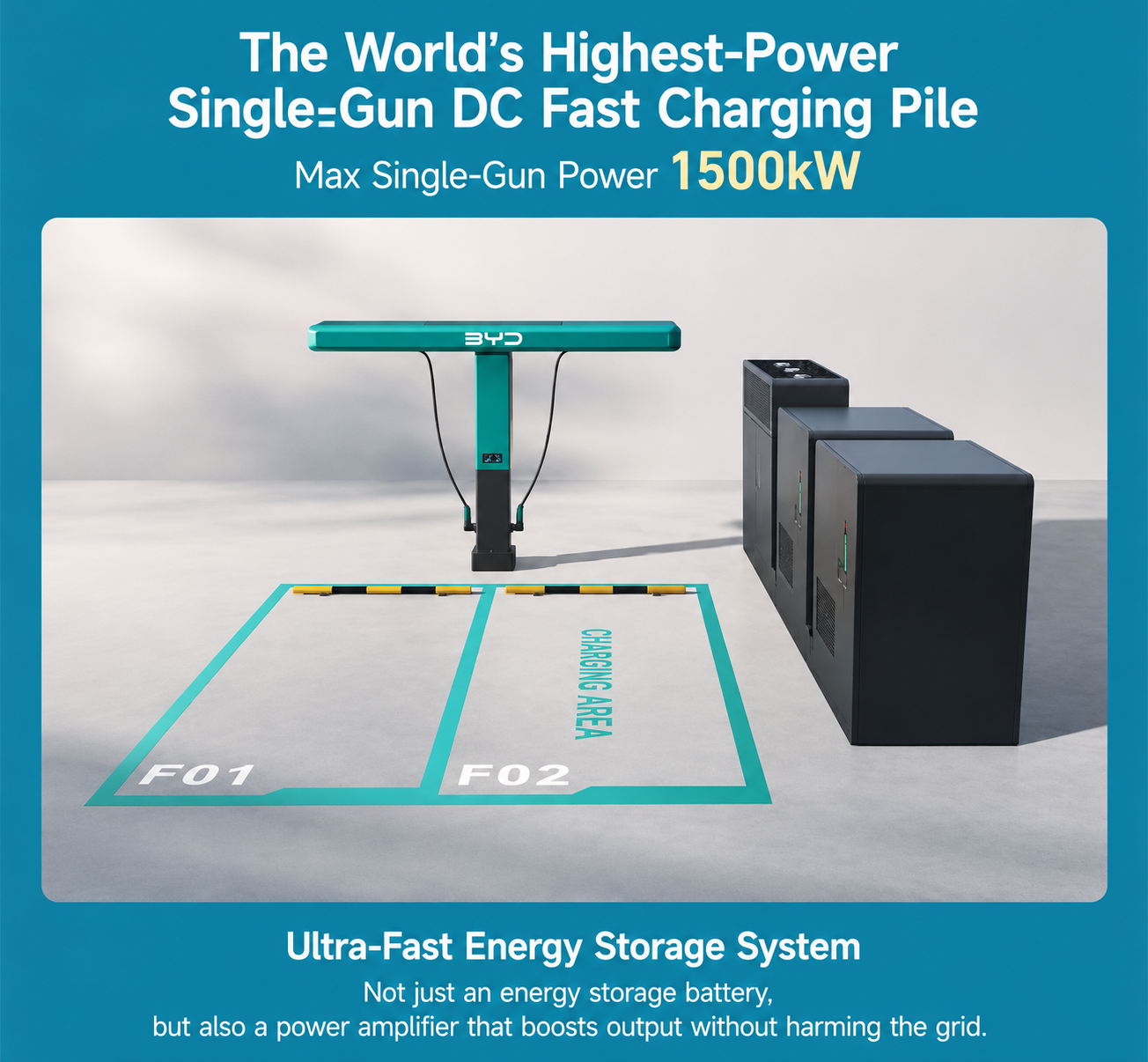
Ultra-fast charging raises a natural concern: will megawatt charging overload the grid? BYD's answer is to pair flash charging with energy-storage cabinets.
A single cabinet can store 200kWh of electricity, and a dual-cabinet setup can reach 400kWh. The cabinets act as a buffer. They charge during off-peak grid periods and discharge during peak demand, reducing the instantaneous load created by high-power charging.
BYD says this can avoid large-scale grid-line reconstruction and substation upgrades. Adding storage cabinets to ordinary charging sites can turn them into flash-charging stations and improve public charging efficiency by 30% to 50%.
The broader model is grid plus storage plus flash charging. If it works, BYD can reduce pressure on the grid while making use of existing charging resources.
The Infrastructure Plan
BYD plans to build 20,000 flash-charging stations by the end of 2026 through a mix of self-built sites and third-party partnerships. The target is to cover highways, core commercial districts, urban communities and county-level markets, reaching more than 80% of core travel scenarios.
The company is also using incentives to accelerate adoption. Owners of vehicles equipped with the second-generation Blade Battery and flash-charging capability are promised one year of free flash charging from delivery. If four owners apply together and BYD's site survey approves the location, the company says installation can begin within a week. The charging piles support plug-and-charge and automatic payment.
The Bigger Meaning
BYD's latest launch is not only about a faster charger. It is an attempt to solve safety, range, low-temperature performance and replenishment as one system.
If the second-generation Blade Battery and flash-charging network scale as planned, BYD could narrow one of the last practical gaps between EVs and petrol cars. That would strengthen its position in the 2026 new-energy market and raise the pressure on rivals whose charging solutions remain slower, more expensive or less widely available.
The final barrier to mass EV substitution may not be whether electric cars can drive far enough. It may be whether they can replenish energy with the same confidence and convenience as petrol cars. BYD is trying to make that question much harder for sceptics to ask.