
Leapmotor delivered 70,289 vehicles in October, crossing the 70,000-unit monthly threshold for the first time and growing more than 84 per cent year on year.
A scale breakthrough with profit behind it
It also remained the top-selling Chinese new-force brand for an eighth consecutive month.
The volume matters because it comes with improving profitability. While many EV start-ups remain trapped in the pattern of rising sales and persistent losses, Leapmotor has posted positive gross margin for two consecutive quarters and became the second Chinese new-force automaker to report half-year profitability in the first half of 2025.
The company's model is built around a simple idea: deep self-development should reduce cost, not simply display technical ambition. That logic runs through its battery systems, electric drives, smart cabins, assisted-driving systems and vehicle architecture.
Self-development as cost control
By the first half of 2025, Leapmotor said 65 per cent of core vehicle components were self-developed or self-manufactured, covering batteries, electric drives, cabins and intelligent-driving systems. That level of vertical integration reduces reliance on external suppliers and gives the company more room to control cost.
Its Pangu battery system uses CTP 3.0 technology to reach a 72 per cent volume utilisation rate. Combined with in-house pack production, the company says battery-pack cost is 15 per cent lower than outsourced supply.
Leapmotor's 27-in-one thermal management system integrates parts that would traditionally be separate, cutting component count by 60 per cent and reducing energy consumption by 10 per cent. Its Pangu electric-drive system, developed with VREMT, raises power density to 2.5kW per kg and costs 22 per cent less than a purchased alternative.
The architecture-level savings are just as important. B-series models based on LEAP 3.5 have an 88 per cent component reuse rate, well above the industry's roughly 60 to 70 per cent norm. That improves purchasing leverage and allows development and production cost to be spread over larger volumes.
The central domain-control design integrates powertrain, assisted driving, smart cabin and body control. Leapmotor also uses a Qualcomm 8650 assisted-driving chip with an 8295 cabin chip, lifting computing power and response speed while reducing hardware complexity.
The economics of a low-price carmaker
Leapmotor has achieved profitability at an average vehicle price of about $14,000, which is what makes its case unusual. In the first half of 2025, gross margin reached 14.1 per cent, up sharply from 1.1 per cent a year earlier. Industry expectations cited in the article suggest that figure could rise to around 15 per cent in the second half.
The margin improvement came because revenue grew faster than cost. In the first half of 2025, revenue rose 174 per cent, while vehicle sales cost increased 138 per cent. The gap converted into stronger gross profit.
Expense control also helped. First-half revenue reached about $3.4 billion, up about $2.1 billion from a year earlier. Combined R&D, marketing and administrative expenses rose by only about $213 million, meaning revenue growth was roughly 10 times the increase in expenses.
That does not mean Leapmotor stopped investing. R&D spending reached about $263 million in the first half, up 54.9 per cent from about $169 million a year earlier, with money focused on assisted driving and new architecture development.
The result was a turnround in profit. Leapmotor reported first-half net profit of about $4 million, compared with a loss of about $307 million a year earlier. Adjusted net profit reached about $46 million.
Light assets and stronger cash flow
Leapmotor also uses a relatively light asset strategy, preferring to lease factories where possible rather than buy them. Founder, chairman and chief executive Zhu Jiangming has often stressed tangible assets and free cash flow over goodwill and intangible assets.
By the first half of 2025, Leapmotor held about $4.1 billion in cash, equivalents and time deposits, while its debt ratio was 71.9 per cent, below the industry average cited in the article. Free cash flow turned positive at about $119 million.
That gives the company more resilience in a price war. It also creates room to develop new revenue sources. Its self-developed battery, electric-drive and control systems are being supplied externally, with potential technology revenue of more than about $1,000 per vehicle, according to the article.
Three moats for the next phase
Leapmotor's first moat is pricing power. Lower costs allow the company to withstand price competition better than rivals that lose more money with each discount. It can cut modestly to defend share while still protecting margins.
The second moat is its "good but affordable" product logic. Cost advantage lets Leapmotor bring newer technology into lower price bands more quickly. That also matters overseas. Through Stellantis' channels, the Leapmotor B10 starts at €29,900 in Germany, 19 per cent cheaper than the Opel Grandland electric version while offering richer intelligent features.
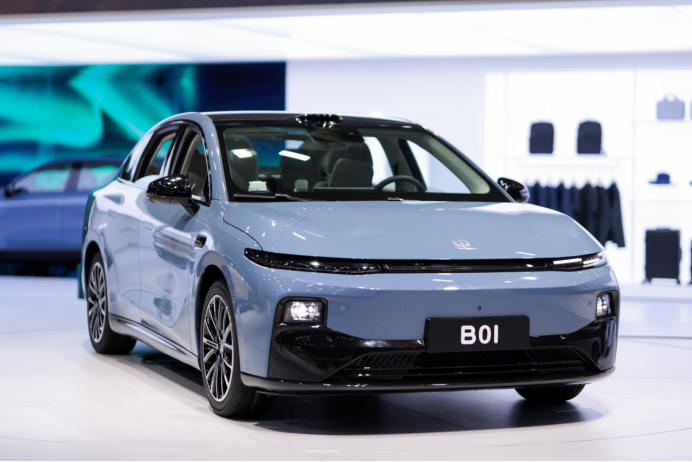
The third moat is a broad product matrix. Leapmotor has built A, B, C and D series products, covering more ground than many new-force peers. Its main B and C series include B01, B10, C10, C11 and C16, with most of those models selling around or above 10,000 units a month.
The line-up covers roughly $11,000 to $42,000, reaching families, younger buyers and business users. That gives Leapmotor both a base to defend and room to move upward.
Can the model be copied?
Zhu has said annual sales of one million vehicles are the survival base for an automaker, because that scale is needed for stable profitability. Leapmotor is not there yet, but its cost structure, cash flow and product breadth make the target more plausible than it once looked.
The lesson is not that every EV company can copy Leapmotor. Deep self-development requires technical discipline, manufacturing competence and enough scale to spread cost. Many companies that try to imitate the model may lack one of those conditions.
The broader lesson is that China's EV competition is moving into a more demanding phase. Burning capital for growth is becoming less acceptable. The companies with the strongest chance are those that can keep technology moving while lowering cost at the same time. Leapmotor has shown one way to do it.