

Leapmotor has opened the second decade of its business with a deliberately provocative product.
A Flagship SUV Priced Like a Mainstream Challenger
Leapmotor has opened the second decade of its business with a deliberately provocative product. The D19 is a full-size flagship SUV with more than 500km of pure-electric range in its extended-range version, a body longer than 5.2 metres, a wheelbase beyond 3.1 metres, an onboard oxygen generator, a refrigerator, heated third-row seats, dual Qualcomm chips and lidar as standard.
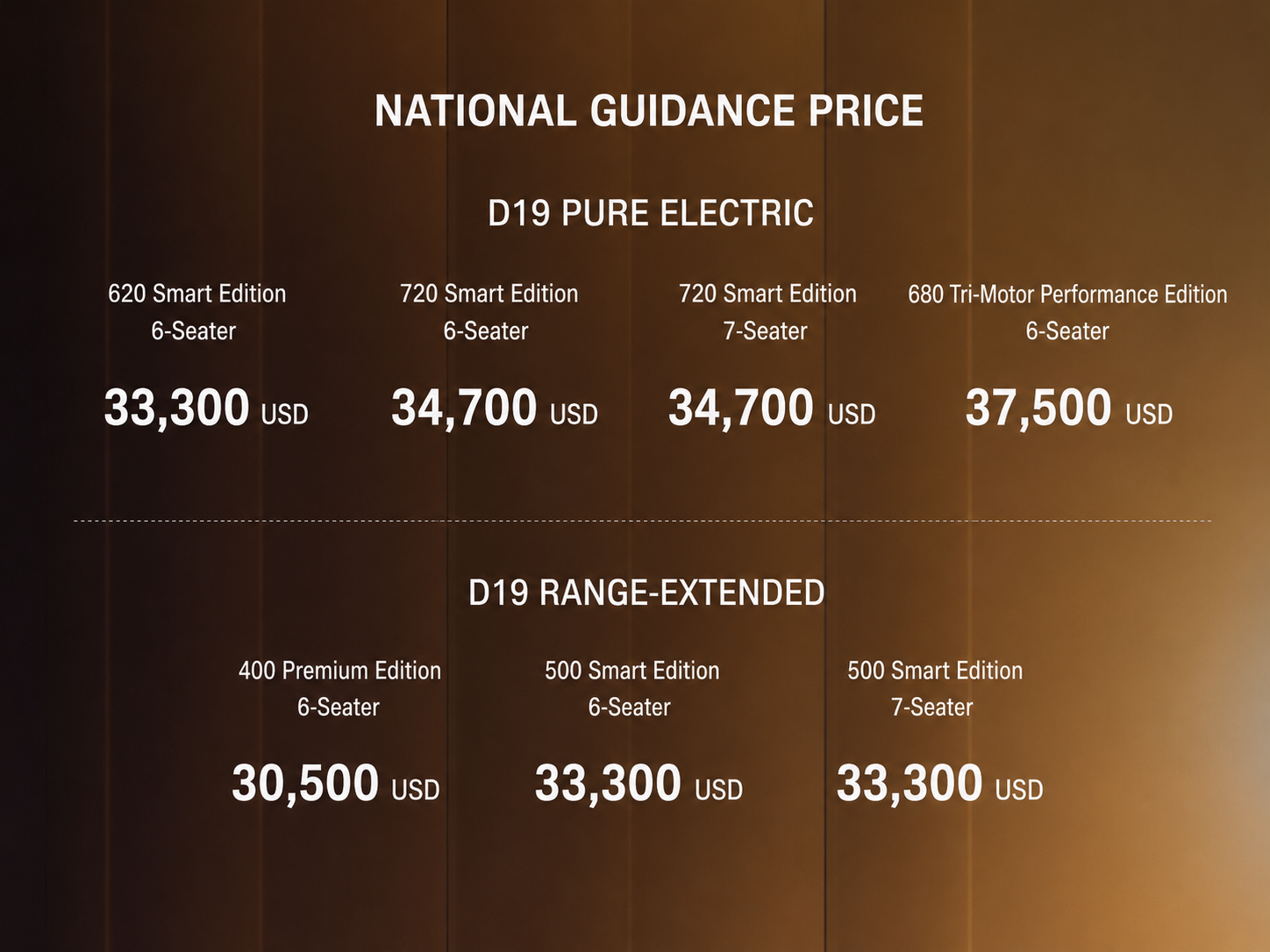
A year ago, many Chinese buyers might have expected that package to cost $48,000, $55,000 or even close to $69,000. Leapmotor has priced the D19 from about $30,000, with the range topping out near $37,000.
The launch came on an evening when at least six new models were competing for attention in China. Internally described as a vehicle ten years in the making, the D19 is Leapmotor's most direct attempt to move the brand upward while staying loyal to its central promise: technology priced close to cost.
Cost-Based Pricing as a Brand Strategy
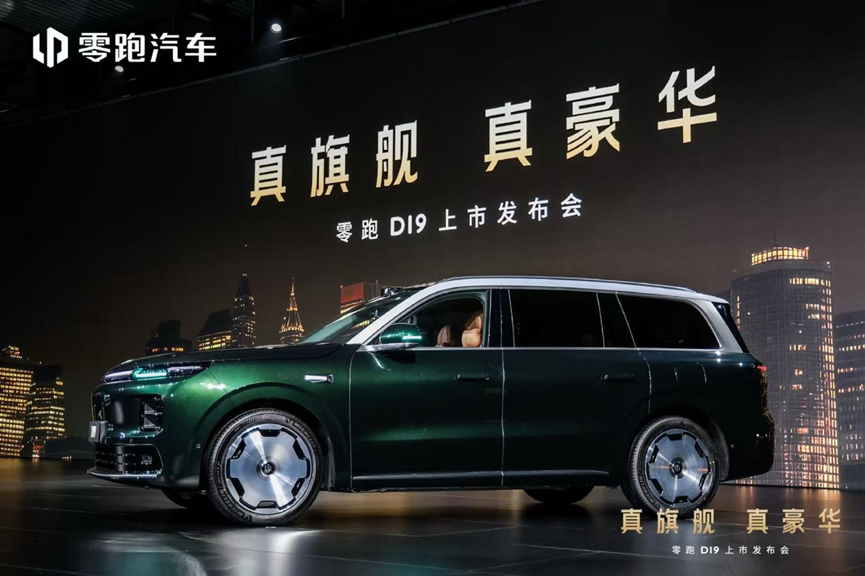
Leapmotor launched the D19 in Jinhua, Zhejiang, on April 16. Built on the LEAP 4.0 technology architecture, the model is positioned as a full-size technology-luxury SUV and is offered with extended-range or pure-electric drivetrains, plus six-seat and seven-seat layouts.
Zhu Jiangming, Leapmotor's founder, chairman and chief executive, told the launch audience that the company chose full-stack in-house development a decade ago because it believed advanced automotive technology should serve ordinary families at rational prices. The D19, he said, was designed to be a complete vehicle with no obvious weakness.
The specification list supports that argument. Across versions, the core hardware and smart features are largely aligned: double-wishbone front suspension, five-link rear suspension, an 80.3kWh battery for the extended-range model, a 115kWh battery for the pure EV, dual Qualcomm 8797 chips, five-screen interaction, L2+ driver assistance including highway navigation, electric adjustment for all seats, heated seats across three rows, nine airbags and a heat-pump air-conditioning system.
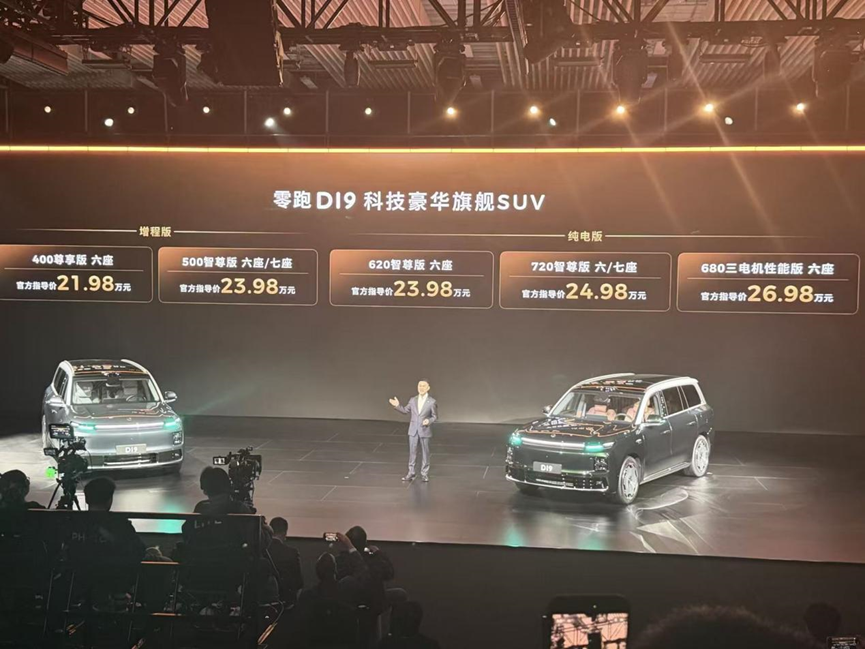
Many Chinese EVs advertise attractive entry prices but push assisted driving, audio and seat-comfort features into paid options, lifting the final transaction price by $7,000 to $8,000. Leapmotor's pitch is more direct: most of the hardware buyers see in the headline package is included from the start.
The main differences are drivetrain choice, two-wheel or four-wheel drive, air suspension and selected comfort options. The D19 measures 5,252mm long, 1,995mm wide and 1,780mm high, with a 3,110mm wheelbase. Leapmotor claims an 88% cabin-space utilisation rate. The six-seat version uses a 2+2+2 layout with a 195mm flat aisle to the third row, while the seven-seat 2+3+2 layout can be turned into a bed through one-touch seat adjustment.
The cabin has 50 storage spaces, and the pure-electric version adds a 176-litre powered front trunk. Comfort equipment includes heated seats for six occupants, ventilation and massage for four seats, and a right-side second-row zero-gravity seat with an integrated ABTS belt. Leapmotor is also promoting an automotive-grade oxygen system with an 8-litre-per-minute output, aimed at reducing fatigue and helping passengers in high-altitude conditions.
Range, Chips and Assisted Driving
The D19's powertrain specification is one of its stronger points. The extended-range version uses an 80.3kWh battery and claims up to 500km of CLTC pure-electric range, making it usable like an EV for much of daily driving. The pure-electric version uses CATL cells with a 115kWh pack and a maximum CLTC range of 720km. It supports 800V-1000V high-voltage fast charging, allowing a large range top-up in 15 minutes.
The top three-motor performance version produces 540kW and is claimed to accelerate from zero to 100kph in 3.94 seconds.
On the intelligent-vehicle side, the D19 uses dual Qualcomm Snapdragon 8797 chips with 1,280 TOPS of AI computing power. Cao Li, Leapmotor's senior vice-president, said that while many carmakers offer 16GB of memory, Leapmotor is using 48GB or 64GB. The company says that headroom is intended to support over-the-air upgrades for the next three to five years.
Lidar is standard across the line. Leapmotor says its VLA large-model system supports 44 driver-assistance functions, including parking-space-to-parking-space navigation, roundabout handling, narrow-road U-turns and 120-metre trace-back reversing.
From Value for Money to Value for Quality
The central question around the D19 is how Leapmotor can offer a flagship-sized SUV at such a low price without losing money. Cao said the company will defend a reasonable gross margin and will not build cars at a loss.
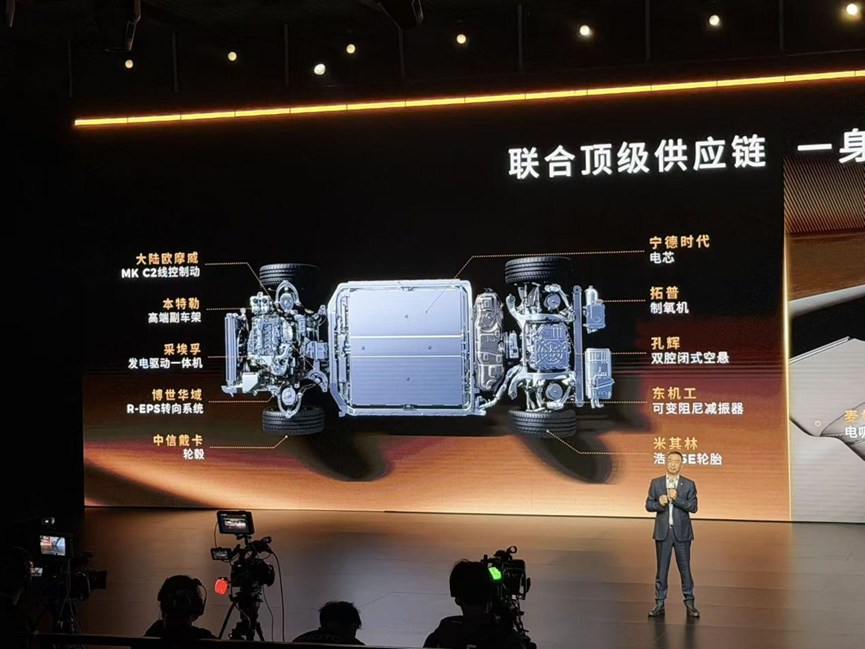
Leapmotor's answer lies in vertical integration. The company develops not only core vehicle components in-house but also much of the automation hardware and software used on its production lines. That reduces labour costs while giving the company more control over quality.
Fei Xiang, the singer and actor serving as brand ambassador for the D series, described Leapmotor's approach after visiting its factory as a practical one: Zhu, he said, saves money from areas that do not materially improve the product and gives it back to the owner through equipment and value.
That thinking explains why Leapmotor held both the A10 and D19 launches in Jinhua. Zhu said the main reason was cost control, arguing that large launch events have become too expensive and that Leapmotor would hold its events in one place this year to reduce waste.
Full-stack in-house development also gives Leapmotor control over technology iteration. The company says more than 65% of its core components are self-developed and self-produced, a share that is expected to rise as 17 component plants continue operating.
Cao calls the approach "technology for all". Whether in the A series below about $14,000 or the D series approaching $41,000, the company says it wants to use cost-based pricing to deliver stronger equipment and quality at the same price point.
The Market Is Becoming an Elimination Round
The D19 enters a Chinese new-energy market that is being reshaped by oversupply and fierce competition. Zhu said the number of models is now excessive and expects the pressure to remain for the next two or three years. After that, he believes the market will normalise and nights with six new-car launches will disappear.
His view is that future demand will polarise. One end will be small vehicles such as Leapmotor's A series, often used as a household's second or third car. The other will be larger family vehicles for shared travel. Traditional A- and B-segment sedans, once chosen because families needed lower-priced transport, may lose ground as household purchasing power improves.
Leapmotor's 2026 product plan follows that logic. The A10 small electric SUV, launched in March, secured more than 30,000 firm orders within 20 days. The D19 moves in the opposite direction, breaking into the segment above roughly $28,000 and carrying the dual task of lifting the brand and improving profitability.
Gasgoo Automotive Research Institute forecasts Leapmotor's 2026 sales at 650,000 to 750,000 units. After selling nearly 600,000 vehicles in 2025, leading China's new carmaking start-ups and recording its first annual profit of about $74 million, Leapmotor has set a 2026 target of 1 million vehicles. Of that, 100,000 to 150,000 units are expected to come from overseas markets. Its longer-term ambition is to become a global carmaker selling 4 million vehicles a year.
From Jinhua to London
Global expansion is becoming central to Leapmotor's next phase. The company was the largest exporter among China's new carmaking start-ups last year, with 67,000 units shipped overseas in 2025.
Fei said he first realised the brand's foreign push was becoming visible when he saw Leapmotor advertising on television at his home in London. He said he already knew the cars were selling well in the UK and Germany, but had not expected to see a Chinese new-energy brand buying repeated TV advertising slots in Britain.

From the A10 to the D19, Leapmotor is trying to write a second chapter that balances scale, profit and brand elevation. The D19's importance is not only that it is large or aggressively priced. It shows that China's EV price war is no longer confined to budget cars. It is moving directly into the territory once protected by premium badges.