
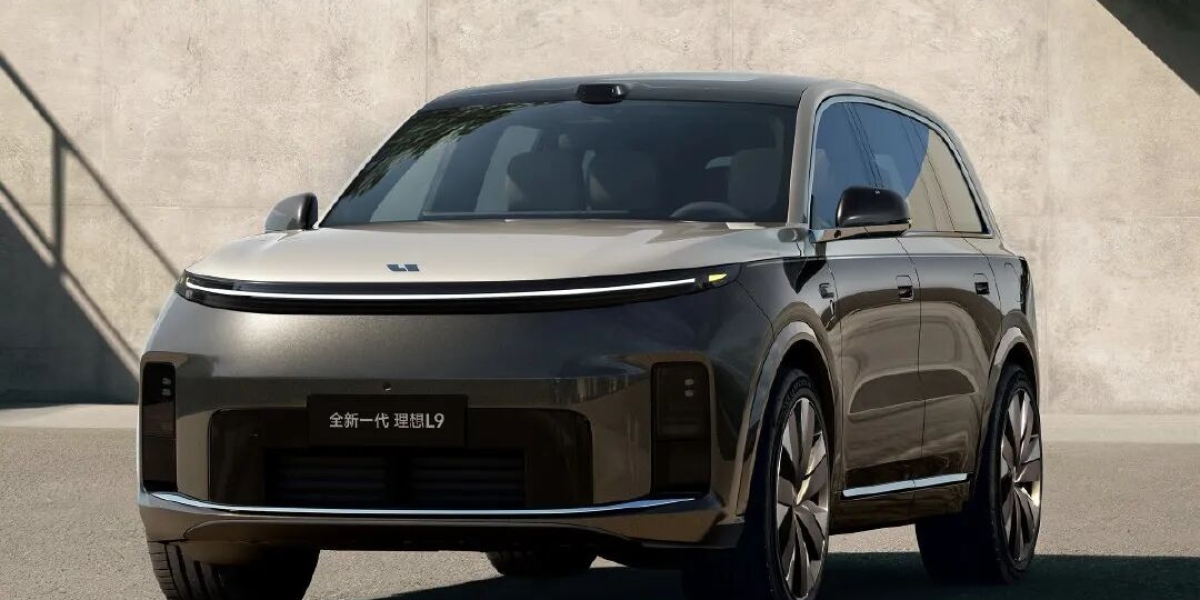
Li Auto remains ambitious. Founder Li Xiang has said the company's 2026 target is to grow deliveries by more than 20% from 406,300 units in 2025. Yet the company's latest annual results show how costly its transition has become.
A Profitable Start-Up Enters a Harder Phase
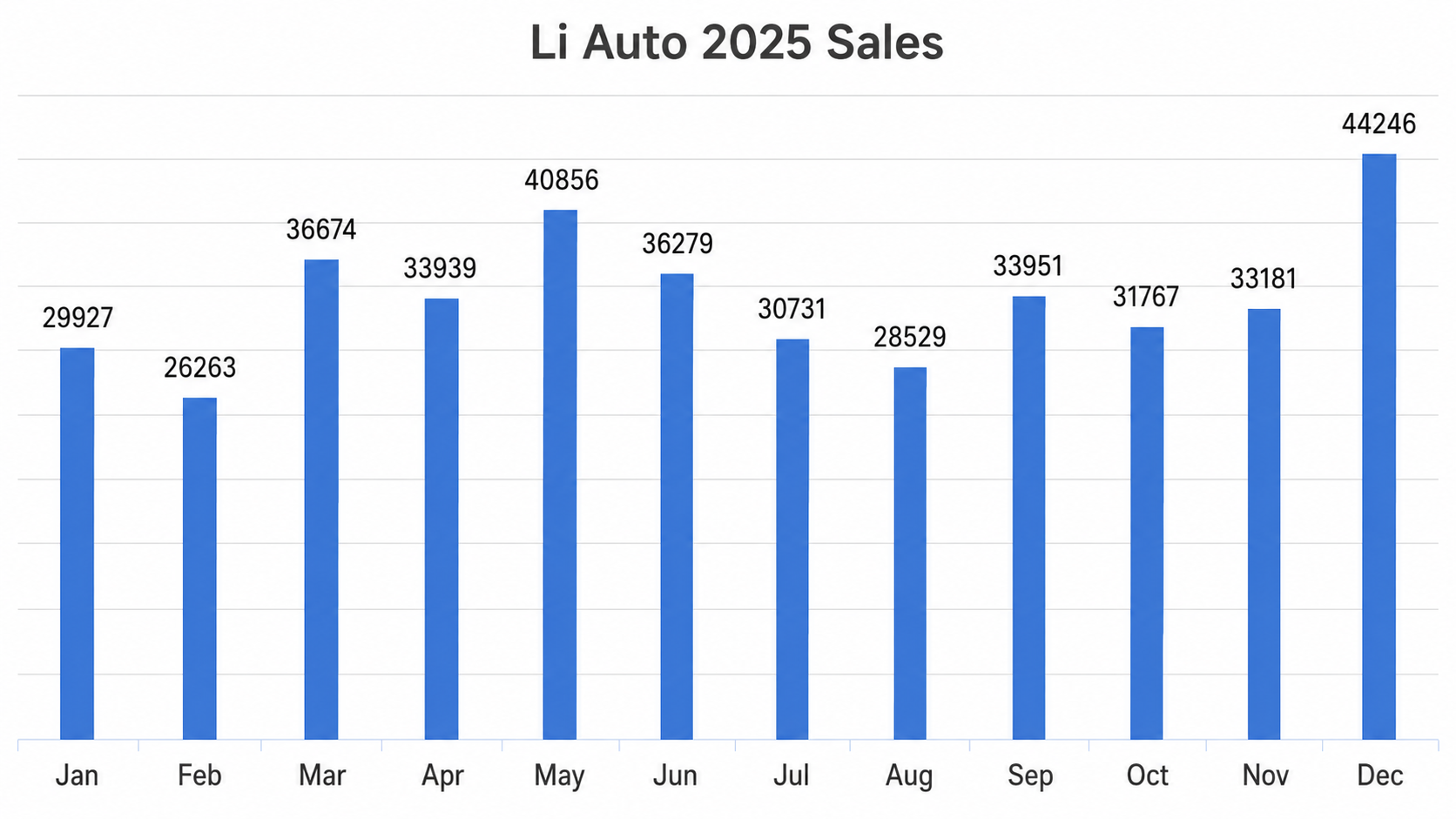
In 2025, Li Auto delivered 406,300 vehicles, down 18.8% year on year. Revenue still held above a symbolic threshold at about $15.5 billion, but net profit fell to roughly $152 million, down 85.8% from about $1.1 billion in 2024. In the fourth quarter, the company returned to profit, but net income was only about $3 million, down 99.4% year on year.
Li Auto, once seen as the most profitable of China's new carmaking start-ups, is now dealing with the sharpest slowdown in its history. The question is whether this is a loss of momentum or a deliberate gear shift before a new phase built around pure EVs and embodied intelligence.
The Range-Extender Advantage Narrows
The immediate cause of the decline was weaker volume and a less favourable product mix. Li Auto missed its original 700,000-unit target for 2025 and also fell short of a later 640,000-unit target. Once the leader among China's start-ups by sales and profit, it slipped to fifth place during the year.
The pressure was concentrated in the L-series family SUVs, Li Auto's core business. Rivals such as Aito and Leapmotor have intensified competition in range-extended vehicles, and the L7, L8 and L9 all showed clear sales declines. The L9's annual volume was close to being cut in half year on year, according to data cited in the original report.
Li Auto's family-SUV formula of space and rich equipment worked well for years. It is less distinctive now that competitors are updating faster. The Aito M9, supported by Huawei ADS advanced driver assistance, has captured significant demand. In some months, Li L9 sales were only about 40% of Aito M9's volume.
The deeper problem is that the original range-extender dividend is fading. As 800V fast charging spreads and battery costs fall, pure EVs are becoming easier to live with. China Passenger Car Association data show that range extenders' share of the new-energy market declined for several consecutive months in the second half of 2025.
Some competing range-extended models now have faster charging systems, while Li Auto's current L-series vehicles still use a 400V platform. Some 2026 facelifts are expected to move to 800V, but the technology gap has already appeared.
The product mix hit profitability. In 2025, Li Auto relied heavily on the lower-priced L6, which accounted for more than 40% of sales. Average selling price fell from about $38,000 in the third quarter to around $34,000 in the fourth. Vehicle gross margin dropped to 16.8% in the fourth quarter and 17.9% for the full year, down from 19.8% in 2024.
The Cost of Going Pure Electric
Li Auto defined 2025 as a year of transition from a single range-extender strategy to a dual range-extender and pure-EV strategy. The opening stages were difficult.
The MEGA, Li Auto's first pure-electric MPV, launched in March 2024 but failed to repeat the success of its range-extended SUVs. Its targets were high, the charging network was not ready enough, and early online controversy damaged momentum. In July 2025, Li Auto launched its second pure-electric vehicle, the i8 SUV, which then faced public debate after a crash-test video. In September, the lower-priced i6 pure-electric SUV gathered strong orders but missed its best sales window because battery-supply constraints delayed deliveries.
In October 2025, Li Auto recalled 11,411 MEGA vehicles because of insufficient coolant corrosion protection. It was the company's first recall and led to a one-time provision of more than $152 million, causing a quarterly net loss of about $86 million and ending 11 consecutive quarters of profit.
There are signs of improvement. President Ma Donghui said on the earnings call that the i6 had passed its most difficult production ramp-up stage and entered stable delivery, with future monthly capacity expected to reach 20,000 units.
Profitability will still be under pressure. Reports suggest the i6's gross margin will remain below 15% before Li Auto completes a battery-supplier transition involving CATL and its own in-house system. To gain ground quickly in pure EVs, Li Auto has chosen more competitive pricing, aiming for parity between petrol-assisted and electric models. Investors may need to adjust earlier expectations of high margins.
The AI Bet
Li Xiang is not responding by cutting ambition. He is spending more and repositioning the company as an embodied-intelligence enterprise.
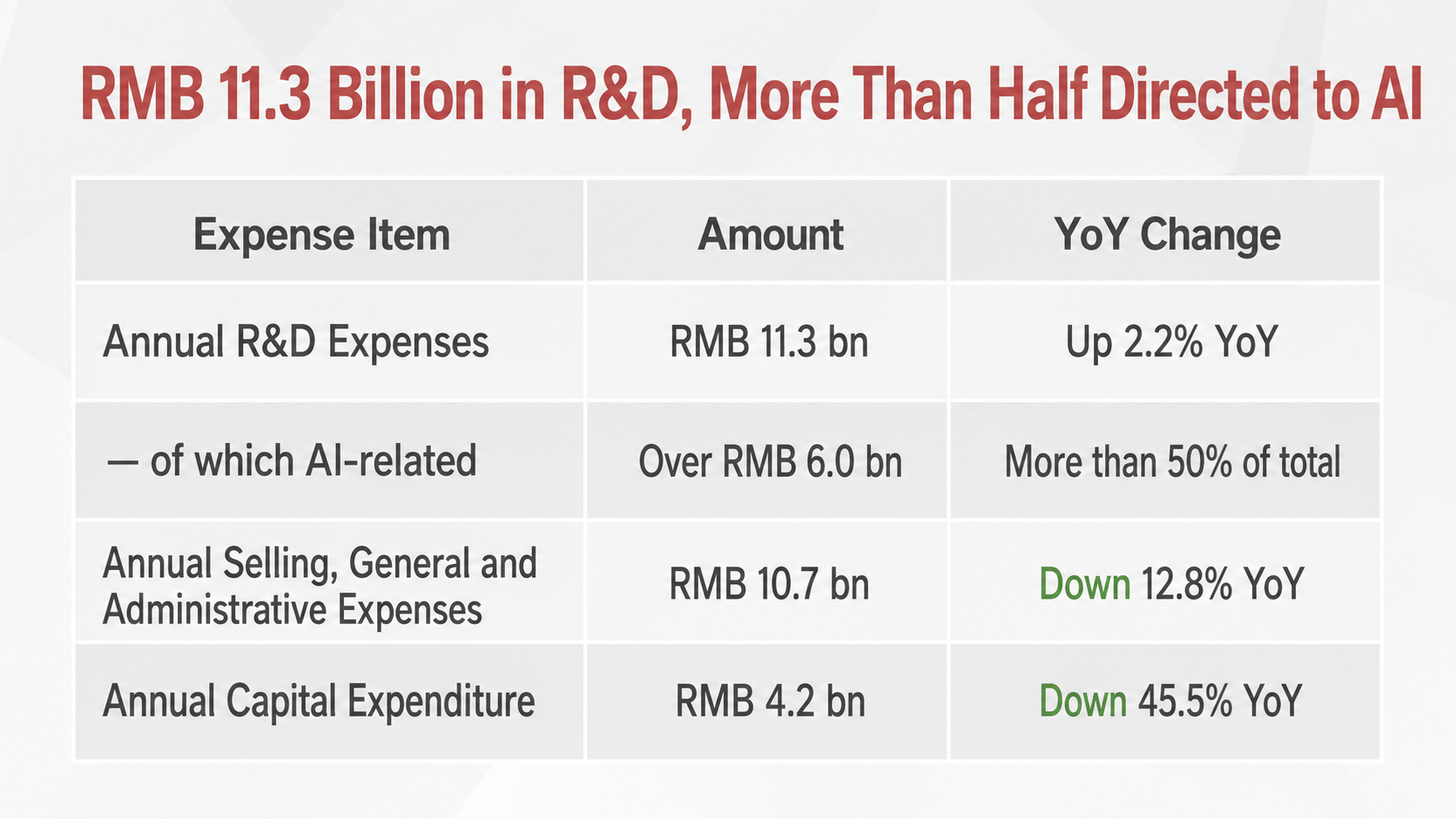
In 2025, Li Auto invested about $1.56 billion in research and development, a record high. More than half went to AI-related work. Its in-house 5nm intelligent-driving chip, M100, has completed tape-out and is being tested in prototype vehicles, with mass production planned for the second quarter of 2026.
Li Auto says a single M100 chip, rated at 1,280 TOPS, can deliver three times the effective computing power of Nvidia's Thor-U when running Li Auto's own VLA model. A dual-chip setup reaches 2,560 TOPS and is claimed to be five to six times stronger. The company's third-generation range extender will also appear on the next-generation L9, bringing upgrades such as nearly imperceptible power generation.
Li Xiang has argued publicly that AI will dramatically widen the gap between average and top-level capability. His view is shaping the company's internal structure. Since the second half of 2025, several senior executives in intelligent driving, product, chips and supply chain have left. Li has pulled core decision-making back to himself and called for a return to start-up mode.
In January 2026, Li Auto reorganised its research and development system around the goal of creating a "digital human". Teams are no longer divided mainly by software and hardware functions, but around foundation models, software bodies and hardware bodies. Li has said a younger generation of managers, including many born in the 1990s and mid-1990s, has taken charge of core business roles.
The sales side is also changing. Li Auto has introduced a store-partner plan that gives store managers more operating authority and profit sharing. Strong managers can decide on customer acquisition, daily operations and team management, moving from sales management toward store entrepreneurship. Li wants top store managers to earn more than about $138,000 a year, with the best reaching roughly three times the industry average.
Products That Must Prove the Strategy
Li Auto still has to regain market rhythm through vehicles. The next-generation L9 is scheduled for the second quarter of 2026. Li Xiang has called it the opening work of an embodied-intelligence robot. It will use the M100 chip and what the company describes as the world's first complete drive-by-wire chassis.
Li has said the success of the new L9 will directly determine the market ceiling for the entire L series. In pure EVs, Li Auto plans to launch the i9 in the second half of the year as a high-end full-size electric flagship SUV, forming a dual-flagship structure with the range-extended L9.
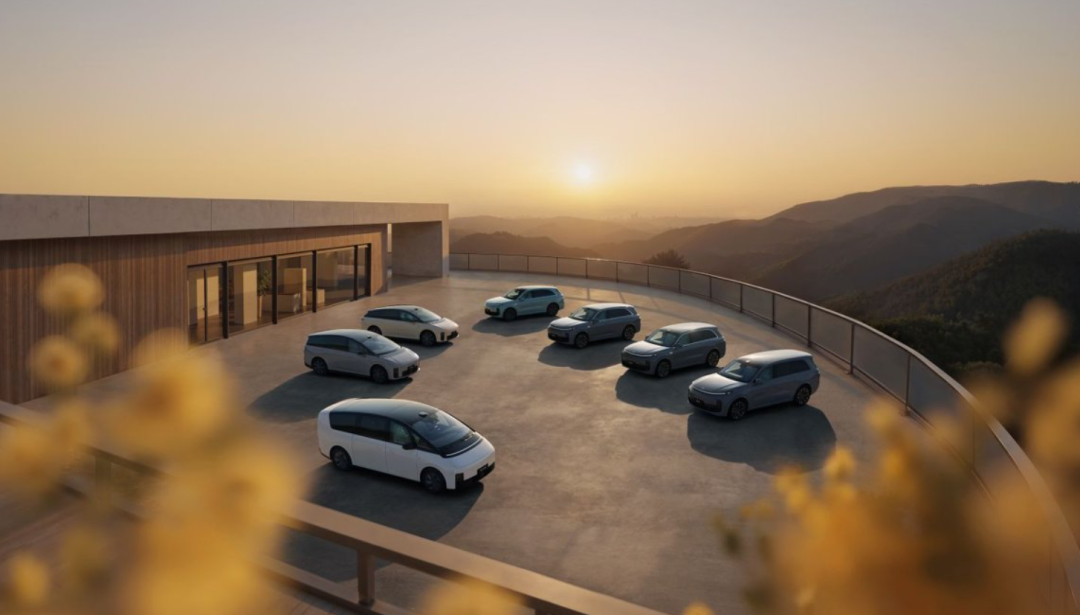
The bet is a contest between the future and the present. The good news is that Li Auto ended 2025 with about $14 billion in cash reserves, the largest among China's new-energy vehicle companies. That gives it time to spend through the transition.
The hard part is that embodied intelligence and large AI models will not quickly repair the car business. The immediate tasks are more conventional: stabilise the L series, scale pure EV deliveries and rebuild margins.
Li Auto's 2025 pain is real. Its 2026 counterattack is urgent. The company is exchanging short-term profit for a chance to enter the next strategic race. The market will soon decide whether that ticket was worth the price.