
China's auto market is heading into the end of 2025 with an unusually intense sales push, driven less by a traditional festive-season promotion than by a change in tax policy.
A year-end rush shaped by policy
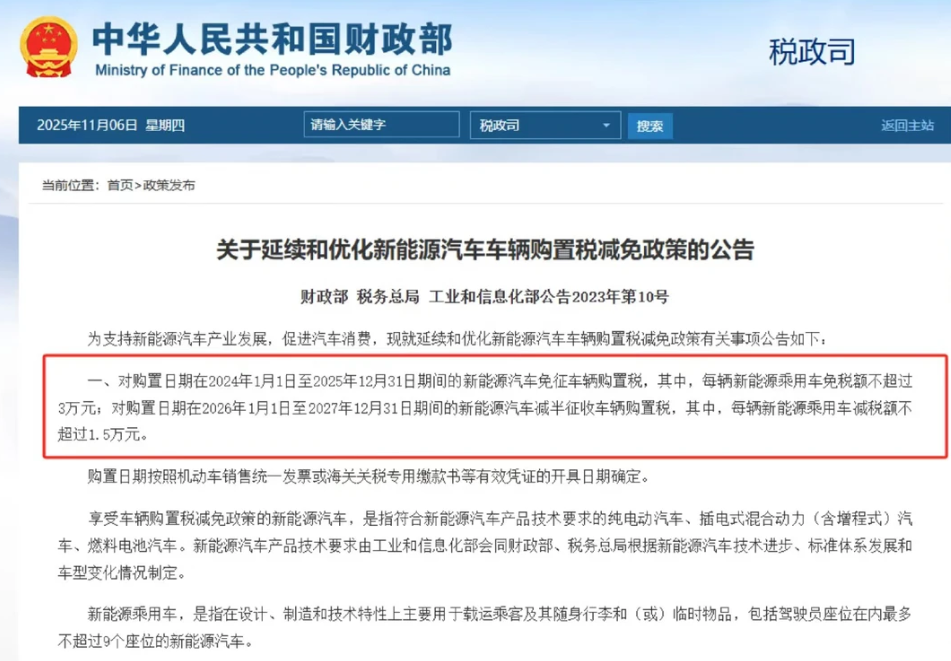
Under rules issued in 2023, buyers of new-energy vehicles enjoyed a full purchase-tax exemption in 2024 and 2025. From January 1, 2026, that benefit is set to be reduced to a half exemption, with the tax saving for each passenger vehicle capped at about $2,000.
That deadline has prompted close to 20 brands to offer what amounts to an insurance policy for buyers. The list includes Li Auto, Nio, Chery, Aito, Luxeed, Xiaomi, Zeekr, IM Motors, Changan, M-Hero, Deepal, Tank, GAC, Dongfeng eπ, Lynk & Co, SAIC Audi, Buick, BYD, Fangchengbao and Denza.
The basic promise is similar across brands. Customers who pay a deposit before December 31, 2025, can lock in their chosen model. If production, logistics or other non-customer reasons push delivery and invoicing into 2026, the automaker will cover the extra purchase-tax cost caused by the policy change.
Why carmakers are covering the gap
The subsidies are more than a late-year discount. For popular models with long waiting times, the promise helps prevent customers from cancelling orders simply because delivery may miss the tax deadline.
It also gives manufacturers a way to smooth demand into the first quarter of 2026, a period many executives expect to be difficult. A weaker subsidy environment, the Lunar New Year holiday and a crowded market could combine to make early-year sales unusually fragile.
Some industry participants believe the mid-February end date used in several support schemes is designed to manage exactly that transition. It allows orders placed in December to be delivered into the first quarter without creating an abrupt break in demand.
The tactic also reflects a deeper anxiety. Nio chairman William Li has said the widely expected fourth-quarter sales surge did not fully materialise, partly because local trade-in subsidies were being phased out. That suggests consumer psychology may now be more sensitive to total ownership cost than to any single national tax measure.
The cost of protecting demand
For buyers, the current window offers a clear financial benefit. A customer who was already planning to buy an EV or plug-in hybrid can reduce the risk of losing the full tax exemption because of delayed delivery.
Yet the details matter. Consumers still need to check whether the brand's support covers their exact model, whether the deposit date is sufficient, how late delivery is defined and whether the subsidy is paid directly or deducted from the final price.
For automakers, the offer cuts both ways. It helps protect order books, but it also adds another layer of sales cost in an industry already squeezed by price competition. Covering several thousand dollars per delayed vehicle can quickly become expensive for brands with heavy order volumes and tight margins.
The policy response therefore becomes a test of operational discipline. Companies with stronger production planning, lower costs and clearer delivery management can use the support as a limited buffer. Weaker players may find that each protected order deepens the strain on profitability.
A preview of the post-subsidy market
The purchase-tax support campaign marks another step in China's move toward a post-subsidy vehicle market. Policy support is not disappearing overnight, but the safety margin is narrowing.
That shift will make product strength, cost control and customer service more important. Automakers can still use short-term incentives to defend sales, yet the market is becoming less willing to reward brands that rely mainly on subsidies or price cuts.
The current order rush may therefore be remembered as a transition point. A policy countdown has triggered a fight for year-end demand, but the longer contest will be about engineering quality, production efficiency and the ability to persuade buyers without constant financial support.