China's 2026 auto market began with a faster and broader price battle than usual. On New Year's Day, BMW adjusted suggested retail prices across 31 main models.
A holiday price shock
Twenty-four models were cut by more than 10 per cent, five by more than 20 per cent, the i7 M70L fell by about $42,000, and the entry 2 Series Gran Coupe dropped to about $29,000, according to the article.
The move quickly spread. Within four days, 16 brands had launched early-year promotions across luxury, joint-venture, independent and new-energy segments. Nearly 70 models were pulled into fresh price competition.
The reason is not only the usual January push. After two months of sales declines at the end of 2025 and expectations of slower growth in 2026, automakers are trying to clear inventory and recover cash before demand weakens further.
Policy support is becoming more selective
For much of the past decade, broad policy support helped lift China's car market. In 2026, that support is becoming more targeted, with a greater emphasis on higher-quality development rather than simple volume growth.
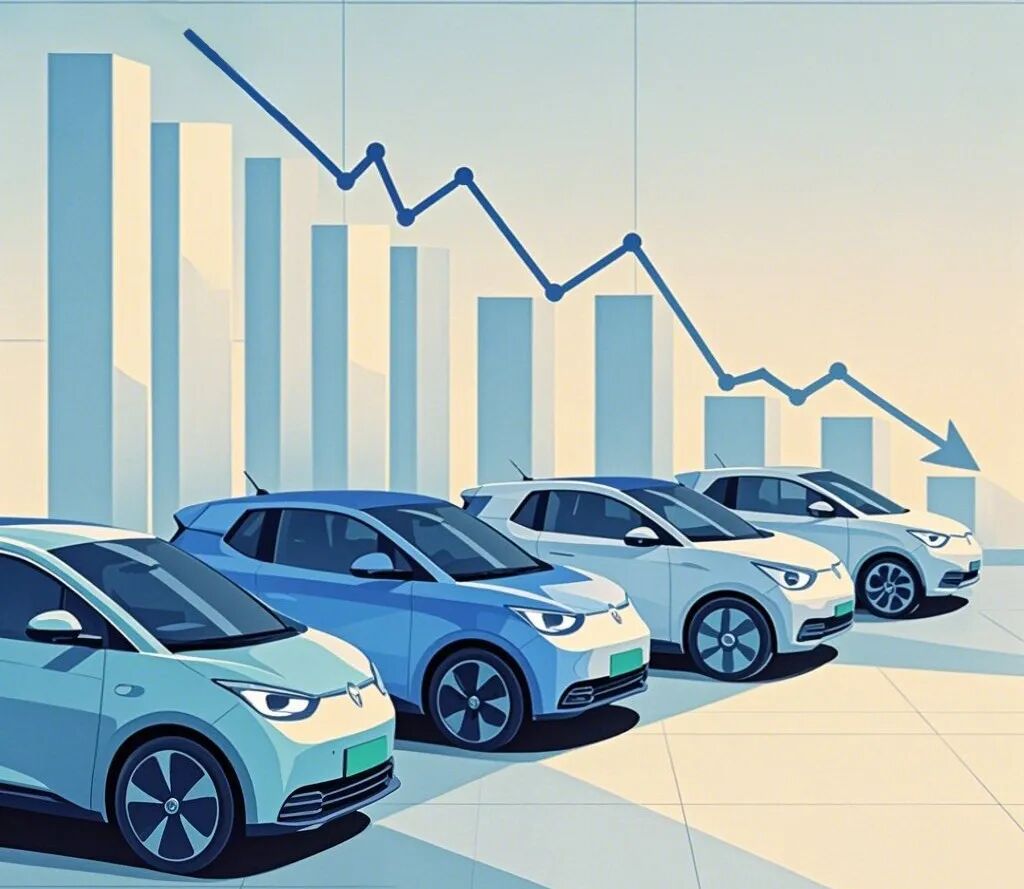
The clearest change is the new-energy vehicle purchase-tax adjustment. From 2026 to 2027, the tax exemption has been reduced to a 50 per cent cut, with the tax reduction for each new-energy passenger vehicle capped at about $2,000. For a roughly $28,000 new-energy vehicle, purchase tax rises from zero to about $1,000, increasing the total purchase cost by about 4.4 per cent. Some premium models face increases above 8 per cent.
Trade-in subsidies are also changing. From 2026, subsidies are calculated as a share of vehicle price rather than a fixed payment. To receive the full new-energy vehicle subsidy of about $2,000, a car must be priced above roughly $26,000. To receive the full fuel-vehicle subsidy of about $2,000, the vehicle must exceed roughly $31,000. Entry-level models below about $21,000 will receive little benefit.
That creates pressure in the segments where many joint-venture and independent brands compete most intensely. Cars that relied on policy support lose price competitiveness, forcing manufacturers to fill the gap through their own discounts.
Demand was pulled forward
Research cited in the article argues that China's market is experiencing a failure of growth inertia. The strong 2024-2025 sales cycle was partly built on pulling forward demand from the next two to three years through subsidies and promotions.
Morgan Stanley forecast that China's domestic passenger-car sales could fall to 28.5 million units in 2026, down 5 per cent year on year. Excluding exports, the domestic decline could reach 7 per cent, with first-quarter sales possibly down 30 to 35 per cent from the previous quarter.
The pressure comes from weaker purchase capacity and more cautious consumer sentiment. Lower income expectations and volatile asset values make large purchases easier to delay. After two years of concentrated replacement demand, the market also faces a visible gap in new buyers.
Technology change adds another reason to clear stock. Solid-state battery industrialisation is accelerating, and 2026 is widely viewed as a key year for vehicle validation. Current liquid-battery EVs could face faster obsolescence over the next one to two years, especially price-sensitive entry and midrange models. Discounts help clear inventory before newer technology resets expectations.

Survival logic is changing
The price cuts reflect a deeper shift in industry survival. Joint ventures are cutting from a defensive position after losing share. Their market share has fallen from about 60 per cent in 2020 to 36 to 38 per cent in 2025, with Korean brands at only 1.1 per cent and French brands at 0.3 per cent, according to the article.
For these brands, discounting is a way to maintain dealer stability. If inventory builds and dealer cash flow breaks, some brands could face much more severe market exits.
Independent Chinese brands are splitting more clearly. Leaders are moving upmarket and investing in technology, while smaller brands with weak technology and similar products may be forced into a discount cycle: lower prices, thinner margins, reduced R&D, weaker products and more dependence on price cuts.
Technology companies are also changing the field. Huawei is expected to launch more than 10 new models across its intelligent-selection and HI Plus cooperation models in 2026, covering everything from roughly $21,000 family cars to luxury models above about $141,000. For traditional automakers, Huawei can be a technology partner, but also a competitive force if their own core capabilities are weak.
The elimination round is accelerating
China's auto industry is moving from rapid adolescence into a mature phase of stock-market competition. Price cuts are only the visible opening of a more severe elimination round.
Industry margins are already under pressure. The article says average automaker profit margins fell from 5.8 per cent in 2020 to 3.2 per cent in 2025, with some companies relying on price-for-volume strategies below 1 per cent. Analysts expect three to five mainstream second-tier joint-venture or independent brands, plus more small brands, to leave the market through exits, restructuring or collapse over the next three to five years.
Market concentration is likely to rise. China Passenger Car Association data cited in the article show the top 10 automakers reaching 73.6 per cent share in 2025. Morgan Stanley expects that to rise to 82 to 85 per cent in 2026.
Two escape routes stand out. The first is overseas expansion. China exported 6.343 million vehicles from January to November 2025, up 18.7 per cent, with November exports reaching a record 728,000. Full-year exports were expected to exceed 7 million, and 2026 exports are forecast to grow about 16 per cent, led by Europe, ASEAN and Latin America.
The second route is technology. R&D investment is expected to rise in solid-state batteries, advanced assisted driving and 800-volt high-voltage platforms. L2 assisted-driving functions, including highway navigation assistance and automated parking, are expected to exceed 70 per cent penetration and become standard on roughly $14,000 economy EVs. L2+ systems, including urban navigation assistance and automated lane changes, are expected to reach 32 per cent penetration.
The 2026 price war is therefore not just a battle over transaction prices. It is the sound of a market deciding which brands have enough technology, cash flow, overseas reach and product credibility to survive the next phase.